Silent Weapons: How Australia's Sharpest Poker Minds Decode the Table Before a Card Is Dealt
There's a moment — right before a big hand plays out — where everything slows down. The cards are irrelevant. The chips are irrelevant. What matters is the bloke across the table who just shifted his weight, glanced at his stack twice, and hasn't touched his drink in twenty minutes. If you caught all three of those things, you're already ahead. If you didn't, you're probably the one being read.
Live casino gaming in Australia is a different beast from anything you'll find on a screen. The Crown Melbourne high-roller rooms, the private poker nights tucked into Sydney's eastern suburbs, the baccarat tables that hum with quiet intensity in Brisbane — these are environments where psychological warfare is as important as card knowledge. And the players who consistently walk away with the biggest stacks aren't always the ones with the best hands. They're the ones who've turned observation into an art form.
The Room Speaks Before Anyone Does
Seasoned high-stakes players will tell you that the information gathering starts the second you walk through the door. Before you sit down, before introductions, before a single chip is placed — the room is already telling you things.
Watch how players interact with staff. A punter who's dismissive to a dealer is often someone running hot emotionally, either on a winning streak that's inflated their ego or a losing run they're refusing to acknowledge. Either way, they're reactive. Reactive players are predictable players.
Notice where people choose to sit when given a choice. Players who position themselves with their backs to the wall tend to be more cautious and deliberate — they want full visual control of their surroundings. Those who sit in the middle of the action, facing the room, are often more comfortable with chaos. That comfort level matters enormously when the pressure ramps up.
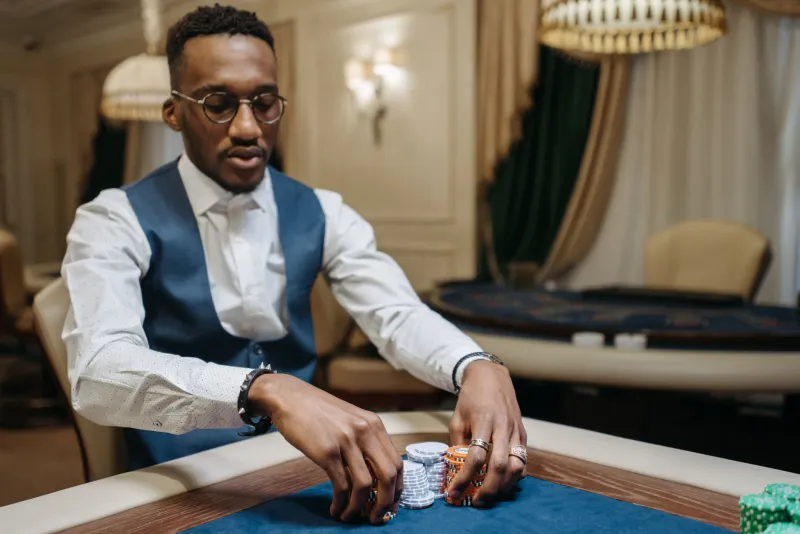
Even the way someone organises their chips tells a story. Neat, colour-coded stacks signal discipline and patience. Messy piles suggest someone playing fast and loose, either through confidence or carelessness — and figuring out which one takes about three hands.
Micro-Expressions: The Leaks You Can't Plug
Human faces are extraordinarily bad liars, even when the rest of the body holds perfectly still. Micro-expressions — those involuntary flickers of emotion that last less than a quarter of a second — are almost impossible to consciously suppress. Psychologist Paul Ekman mapped seven universal expressions that cross cultural lines, and every single one of them shows up at casino tables.
The key ones to watch for in live poker or baccarat? Contempt and surprise.
A microflash of contempt — a slight curl at one corner of the mouth — often appears when a player looks at a strong hand. It's subtle, but it's there. They know they've got you, and for just a fraction of a second, their face agrees.
Surprise, on the other hand, is the tell that gives away a missed draw or an unexpected community card. The eyes widen fractionally, the brow lifts. It happens before the brain can shut it down. If you see surprise on the face of someone who was betting aggressively, pump the brakes — the board just changed their world.
The trick is training yourself to watch faces at the exact moment the cards are revealed, not the cards themselves. That's counterintuitive. It takes practice. But once you build that habit, the table starts to feel like it's playing in slow motion.
Breathing, Posture, and the Tells Nobody Talks About
Body language in a casino context goes well beyond the classic "touching the face means lying" territory. The real signals are subtler, and they're often physiological rather than behavioural.
Breathing is one of the most reliable indicators of stress or excitement. When someone's holding a monster hand and trying to keep a lid on it, their breathing becomes shallow and controlled — you'll notice the chest barely moves. Conversely, when someone's bluffing under pressure, the body's stress response kicks in and breathing becomes slightly faster and more visible. Watch the shoulders. Watch the collar. It sounds clinical, but it becomes second nature quickly.
Posture shifts are equally telling. A player who leans back slightly after the flop is often comfortable with what they're holding. Someone who unconsciously leans forward is engaged, possibly excited — possibly overcommitted to a hand they shouldn't be. And the player who suddenly goes completely still? That's the one to be most afraid of. Stillness under pressure is often a sign of someone who's found exactly what they were looking for.
Environmental Awareness as Competitive Advantage
Beyond individual opponents, the broader environment carries information that most players ignore entirely. Table dynamics shift throughout a session, and tracking those shifts is its own skill set.
Pay attention to the energy cycles at your table. After a massive pot, there's almost always a psychological reset — players recalibrate, some tighten up, others overcompensate by going looser. That transitional window, the three to five hands after a big hand, is often where the most exploitable play happens. People are still processing. You shouldn't be.
Noise levels matter too. When a table gets louder — more banter, more laughter — the general standard of play often dips. Social comfort breeds complacency. Conversely, a quiet table is a focused table, and bluffing into that environment carries more risk because everyone is paying attention.
In baccarat rooms especially, watch the rhythm of the game. Experienced Australian baccarat players know that the pace of betting — how quickly punters commit chips — communicates confidence levels across the whole table. When the room slows down collectively, something has shifted in the group psychology. That hesitation is worth noting.
Building Your Own Baseline
None of this works without a baseline. Before you can spot a deviation, you need to know what normal looks like for each player at your table.
Spend the first twenty minutes of any session in pure observation mode. Don't try to exploit anything yet. Just watch. How does each player react when they win a small pot? How do they handle a bad beat? What does their neutral face actually look like? Establishing that baseline makes every subsequent deviation meaningful.
The players who dominate Australia's high-stakes live rooms — from the underground poker circuits to the premium casino floors — aren't just technically sound. They're constantly running a background process, cataloguing behaviour, updating mental models, and storing information for exactly the right moment.
Cards run hot and cold. Luck evens out. But the ability to read a room? That's a skill that compounds over time, and at the extreme end of the game, it's often the only real edge left on the table.